Description
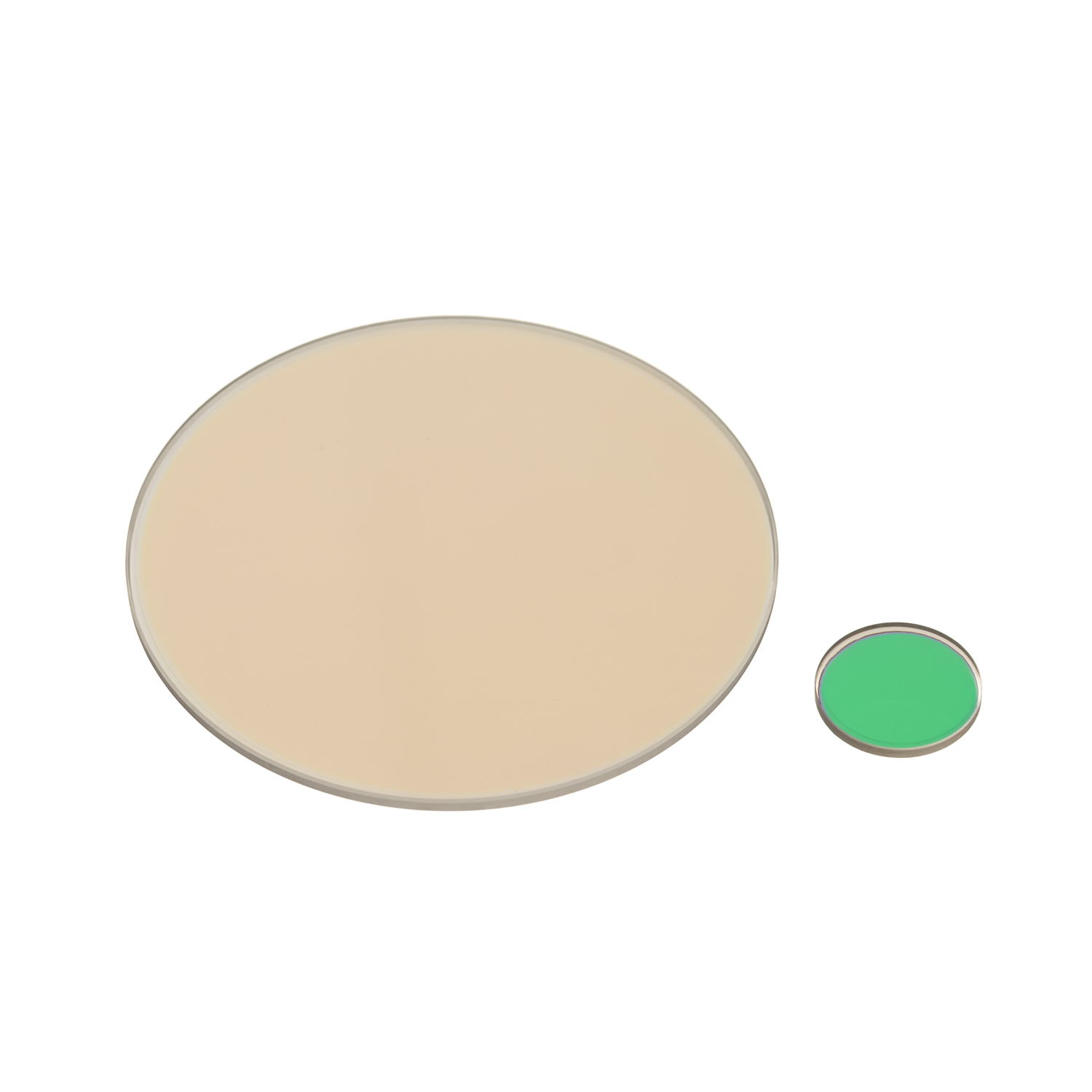
Retardation plates are used to change the polarization state of a light beam. With non-polarized light, these plates have the same effect as a window. Crystalline (birefringent) quartz is used to create a phase shift in one of the two directions of oscillation of the light in relation to the crystal-optical axes, thereby changing the polarization state. The most common plates are lambda/2 and lambda/4 plates, which generate a half and a quarter phase shift respectively. Lambda/4 plates transform linear-polarized light, whose polarization direction is rotated by 45° to the crystal-optical axis, into circular-polarized light. A different orientation of the polarization plane produces elliptically polarized light. Lambda/2 plates rotate the polarization direction. If the polarization plane has an angle of alpha to one of the crystal-optical axes when entering the lambda/2 plate, the angle is -alpha when the polarization plane exits. Retardation plates are also available in different orders. A retardation plate of the nth order shifts one of the directions of oscillation n times by its complete wavelength.
Application areas
Industrial laser engraving and cutting
Medical laser devices
Optical metrology
Scientific research
Order information
Our lenses are manufactured according to your specific requirements. Contact us for a customized offer. Please let us know the exact specifications and requirements.